
You underwent rhinoplasty hoping for a straighter, more balanced nose. But after months of healing, something still doesn't look quite right. Maybe your nasal bridge leans to one side, your tip appears off-center, or your nose looks straight from the side but noticeably crooked in photographs taken from the front.
If you've already had nose surgery and aren't happy with the results, you may be wondering: Can revision rhinoplasty actually straighten a crooked nose, or will it always look somewhat uneven?
Yes, revision rhinoplasty can often significantly straighten a crooked nose. By correcting underlying issues involving the nasal bones, septum, cartilage, and structural support, an experienced facial plastic surgeon can improve nasal alignment and symmetry. However, perfect straightness cannot be guaranteed, especially when previous surgery has caused significant scarring or altered the nose's natural framework.
At The Spiegel Center in Newton, Massachusetts, just outside Boston, double board-certified facial plastic surgeons Dr. Jeffrey Spiegel and Dr. Jacob Tower specialize in complex facial procedures, including revision rhinoplasty. Their approach focuses on identifying the cause of the crooked nose, addressing underlying structural concerns, and achieving a natural-looking result that complements the patient's facial features.
Why Is My Nose Still Crooked After Rhinoplasty?
A crooked nose after rhinoplasty can develop for several reasons. Sometimes the original deviation wasn't fully corrected. In other cases, changes during healing or weakened nasal support can affect the final appearance.
Understanding the cause is essential because not every crooked nose requires the same surgical correction.
1. The Nasal Bones Are Still Misaligned
The upper portion of your nose is supported by bone. If these bones remain displaced or heal in an uneven position, the nasal bridge may continue to lean toward one side.
Revision rhinoplasty may involve carefully repositioning the nasal bones to improve alignment.
2. The Septum Is Deviated
The septum is the internal wall of cartilage and bone separating the nasal passages. It also plays an important role in supporting the external nose.
A significantly deviated septum can cause the bridge or nasal tip to appear off-center and may contribute to breathing difficulties. In these cases, straightening the nose may require correcting the septum rather than simply reshaping the visible nasal bridge.
3. Scar Tissue Has Affected the Shape
Scar tissue is a normal part of healing after rhinoplasty. However, uneven or excessive scar formation can influence nasal contours and sometimes pull tissues in an undesirable direction.
Scar tissue also makes revision surgery more complex because it can reduce tissue flexibility and obscure the original anatomy.
4. Cartilage Has Shifted or Lost Support
The nasal tip and middle portion of the nose rely heavily on cartilage for shape and stability.
If cartilage was removed, weakened, or repositioned during the first surgery, the nose may develop asymmetry or structural collapse. Some cartilage also has a natural tendency to curve, which can make maintaining a straight alignment more challenging.
5. Your Face Is Naturally Asymmetrical
One of the most overlooked reasons a nose appears crooked is the relationship between the nose and the rest of the face.
Most faces have some degree of natural asymmetry. Differences in the cheeks, jaw, or position of the facial midline can influence how straight the nose appears.
A nose doesn't exist in isolation. Successful rhinoplasty requires evaluating how its shape and position relate to the surrounding facial features.
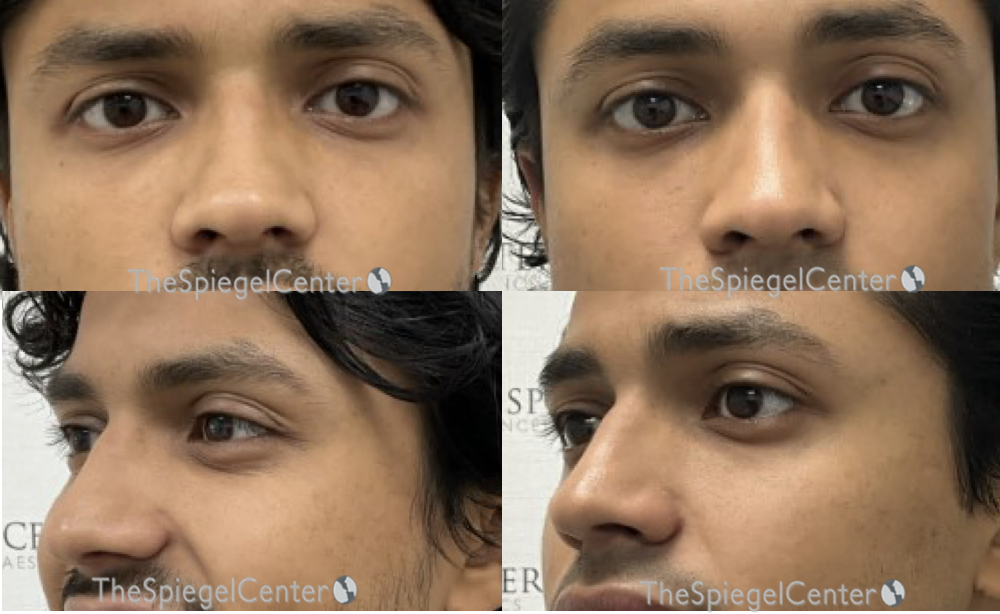
Real Patient Results - Before & After Revision Rhinoplasty
Can Revision Rhinoplasty Make a Crooked Nose Completely Straight?
This is one of the most important questions to discuss with your surgeon.
Revision rhinoplasty can produce substantial improvements in nasal straightness, but achieving a perfectly symmetrical nose is not always anatomically possible.
The degree of correction depends on several factors:
- How significantly the nose is deviated
- Whether the crookedness involves bone, cartilage, or both
- The amount of scar tissue from previous surgery
- How much structural cartilage remains
- The flexibility and thickness of the nasal skin
- Whether the patient has undergone multiple rhinoplasties
- The degree of natural facial asymmetry
For some patients, relatively focused adjustments can noticeably improve nasal alignment. Others require more extensive structural reconstruction.
At The Spiegel Center, Dr. Spiegel and Dr. Tower evaluate these factors before recommending a surgical approach.
The goal isn't simply to make the nose look straighter in one photograph. It's to create improved alignment, stable structural support, and a balanced-looking nose from multiple angles.
Revision Rhinoplasty Before and After: What Results Are Possible?
One of the best ways to understand what revision rhinoplasty may accomplish is to examine actual surgical results.
At The Spiegel Center, Dr. Jeffrey Spiegel and Dr. Jacob Tower perform revision rhinoplasty for patients seeking to improve nasal shape, symmetry, and function following prior surgery.
Our before-and-after gallery features real patients who have undergone revision rhinoplasty at our practice.
View Revision Rhinoplasty Before-and-After Photos at The Spiegel Center
When evaluating before-and-after photographs, pay particular attention to the front view. While side-profile images can demonstrate improvements in the nasal bridge or tip projection, front-facing photographs are especially helpful for assessing nasal alignment and symmetry.
It's also important to remember that every revision is different. A patient with a mildly crooked bridge may require a very different surgical approach from someone with significant septal deviation or weakened cartilage after multiple operations.
How Do Surgeons Straighten a Crooked Nose During Revision Rhinoplasty?
Straightening a previously operated nose is often more complicated than simply moving it toward the center. The surgeon must identify which structures are responsible for the deviation and determine how to correct them while maintaining proper nasal support. Depending on the patient's anatomy, several techniques may be used.
Repositioning the Nasal Bones
If the upper nasal bridge is crooked, the surgeon may perform controlled bone adjustments called osteotomies. These allow the nasal bones to be repositioned to improve the overall alignment of the bridge.
Correcting a Deviated Septum
When the septum contributes to the external deviation, septal reconstruction may be necessary. Straightening and stabilizing the septum can improve the appearance of the nose while also addressing certain breathing problems.
Using Cartilage Grafts to Rebuild Support
In some revision rhinoplasty cases, there may not be enough healthy cartilage remaining from the original surgery.
Cartilage grafts may be used to rebuild weakened structures, reinforce the bridge, or support the nasal tip. Depending on the patient's needs, cartilage may be obtained from the septum, ear, or rib. Processed donor cartilage may also be considered in select cases. These grafts can be particularly important when previous surgery has caused structural collapse or significant asymmetry.
Correcting an Asymmetrical Nasal Tip
A crooked nasal tip can result from uneven cartilage, weakened support, or scar tissue. Revision surgery may involve reshaping or repositioning the tip cartilages, adjusting sutures, or adding structural grafts. The key to a successful correction is addressing the underlying cause of the asymmetry rather than simply disguising it.
Why Is Revision Rhinoplasty More Difficult Than the First Surgery?
Revision rhinoplasty is among the more technically demanding procedures in facial plastic surgery.
During an initial rhinoplasty, the surgeon generally works with nasal structures that have not previously been altered. During revision surgery, the anatomy may be significantly different.
Scar tissue can make it more difficult to separate tissues. Cartilage may have been removed or repositioned. The nasal framework may be weakened, and the skin may be less flexible. In some cases, the surgeon must reconstruct portions of the nose before making the desired aesthetic improvements.
This is why choosing a surgeon with experience in complex revision rhinoplasty is especially important.
At The Spiegel Center, Dr. Jeffrey Spiegel and Dr. Jacob Tower bring specialized training in facial plastic surgery to both primary and revision rhinoplasty. Their approach considers nasal anatomy, structural stability, breathing function, and overall facial harmony. For patients seeking revision rhinoplasty in Boston, the goal is not simply another nose surgery. It is a carefully planned correction based on what happened during the previous procedure and what can realistically be improved.
Can Revision Rhinoplasty Improve Both a Crooked Nose and Breathing Problems?
Yes. In some patients, the structural abnormalities responsible for a crooked nose also contribute to difficulty breathing.
A deviated septum, weakened nasal valves, or collapsed cartilage can affect airflow through the nasal passages. Depending on the underlying problem, revision rhinoplasty may address both cosmetic and functional concerns, including:
- A crooked or deviated nasal septum
- Internal or external nasal valve collapse
- An asymmetrical nasal bridge
- Structural narrowing of the nasal passages
- Nasal tip deviation associated with weakened support
However, not every crooked nose causes breathing difficulties, and not every breathing problem can be corrected through rhinoplasty. A detailed examination helps determine whether structural correction may improve both appearance and function.
What If You've Already Had More Than One Rhinoplasty?
Patients who have undergone multiple nasal surgeries often worry that another correction may no longer be possible.
Although additional procedures can become increasingly complex, having undergone more than one rhinoplasty does not automatically eliminate the possibility of improvement. The primary concerns are often the amount of remaining cartilage, existing scar tissue, skin condition, and stability of the nasal framework.
At The Spiegel Center, patients seek consultations for complex revision cases, including those involving multiple previous procedures. One patient who underwent a second revision rhinoplasty with Dr. Spiegel described concerns about the appearance of the nose from the front, including an asymmetrical tip and nostrils, following earlier surgery.
After consulting with Dr. Spiegel, the patient chose to proceed with another revision and later shared a positive early recovery experience. This illustrates an important point: even when previous rhinoplasty procedures haven't produced the desired result, further improvement may still be possible.
However, each additional surgery must be evaluated carefully, and some patients may be better served by avoiding another operation.
How Long Does It Take for a Crooked Nose to Look Straight After Revision Rhinoplasty?
Recovery after revision rhinoplasty requires patience, particularly when significant structural correction has been performed.
Although some improvements may be visible when the nasal splint is removed, swelling can temporarily make the area appear uneven.
A typical recovery timeline includes:
- First 1–2 weeks: Initial bruising and swelling begin to improve. Many patients can return to non-strenuous work within approximately 7–10 days.
- First 1–3 months: Swelling continues to decrease, revealing more of the underlying nasal shape.
- 3–6 months: Nasal definition becomes more apparent, although residual swelling may still affect symmetry.
- 6–12 months: The nose continues to refine as the tissues heal.
- 12–18 months or longer: Final changes may continue, particularly around the nasal tip or after extensive reconstruction.
It's important not to judge the final alignment of your nose too early. If your nose appears slightly crooked during recovery, the cause may be temporary swelling rather than a persistent structural problem. Your surgeon can help distinguish normal healing from concerns that require additional evaluation.
How Long Should You Wait Before Correcting a Crooked Nose After Rhinoplasty?
If your nose still looks crooked a few months after surgery, you may be eager to schedule a revision.
However, performing another rhinoplasty before the tissues have sufficiently healed can make the procedure more challenging. Many surgeons recommend waiting approximately 12 months after the initial rhinoplasty before considering revision surgery.
This allows swelling to resolve, scar tissue to mature, and the nasal structures to stabilize. The appropriate timing depends on the individual situation. Significant functional problems or other complications may warrant earlier evaluation.
A consultation with a revision rhinoplasty specialist can help determine whether additional healing time is needed or whether corrective surgery may be appropriate.
Choosing a Revision Rhinoplasty Specialist in Boston
When your primary concern is a crooked nose after previous surgery, choosing the right surgeon is one of the most important decisions you can make.
Revision rhinoplasty requires an understanding of how nasal bones, cartilage, the septum, and surrounding tissues work together. It also requires the ability to identify which problems can realistically be corrected and which limitations may remain.
At The Spiegel Center, Dr. Jeffrey Spiegel and Dr. Jacob Tower are double board-certified facial plastic surgeons with experience in complex nasal procedures. Dr. Spiegel has spent more than two decades specializing in facial plastic surgery, including challenging revision cases. Dr. Tower combines specialized facial plastic surgery training with a focus on nasal aesthetics, structural support, and breathing function.
Their approach emphasizes individualized surgical planning rather than a standardized nose shape.
Located in Newton, Massachusetts, The Spiegel Center welcomes patients from Boston, Brookline, Cambridge, Chestnut Hill, throughout New England, and across the country. For patients traveling to Boston for revision rhinoplasty, our team can help coordinate consultations and discuss recovery planning.
Frequently Asked Questions About Crooked Nose Revision Rhinoplasty
Can revision rhinoplasty completely fix a crooked nose?
Revision rhinoplasty can often significantly improve a crooked nose by correcting misaligned bones, a deviated septum, or asymmetrical cartilage. However, perfect symmetry cannot be guaranteed. Scar tissue, previous surgical changes, and natural facial asymmetry can limit the degree of correction possible.
Why does my nose look crooked from the front after rhinoplasty?
A nose may appear crooked from the front because of residual septal deviation, asymmetrical cartilage, uneven bone alignment, or swelling. Natural facial asymmetry can also influence its appearance. An examination can help determine whether the problem is temporary or structural.
Can a crooked nose become crooked again after revision rhinoplasty?
Yes. Although revision surgery aims to create stable alignment, scar tissue contraction, cartilage characteristics, and healing changes can contribute to persistent or recurrent asymmetry. Proper structural support helps reduce these risks, but no surgical outcome can be guaranteed.
Can revision rhinoplasty fix a crooked nasal tip?
Yes. An off-center nasal tip can often be improved by repositioning, reshaping, or reinforcing the underlying cartilage. The achievable result depends on the condition of the existing structures and the effects of previous surgery.
Can a deviated septum make my entire nose look crooked?
Yes. The septum provides important structural support to the nose. A significant deviation can affect the alignment of the nasal bridge or tip and may also contribute to breathing difficulties.
Is revision rhinoplasty more difficult than primary rhinoplasty?
Generally, yes. Revision rhinoplasty often involves scar tissue, altered anatomy, weakened cartilage, and reduced structural support. These factors can require more extensive planning and reconstructive techniques.
Can revision rhinoplasty fix a nose that was broken before the first surgery?
Revision rhinoplasty may improve persistent nasal deformities associated with previous trauma, including crooked bones or septal deviation. The degree of improvement depends on the existing anatomy and any changes made during earlier surgery.
How do I know if I need revision rhinoplasty or more healing time?
If your initial rhinoplasty was performed less than a year ago, swelling and tissue changes may still be affecting the appearance of your nose. Many patients are advised to wait approximately 12 months before undergoing revision surgery, although earlier evaluation may be appropriate for certain complications.
Who performs revision rhinoplasty in Boston?
At The Spiegel Center in Newton, Massachusetts, Dr. Jeffrey Spiegel and Dr. Jacob Tower perform revision rhinoplasty for patients seeking correction of nasal asymmetry, structural irregularities, and certain breathing concerns after previous nose surgery.
A Straighter, More Balanced Nose May Still Be Possible
If you've already undergone rhinoplasty and your nose still looks crooked, you may have more options than you realize.
Revision rhinoplasty can address many of the structural issues responsible for persistent nasal asymmetry, including misaligned nasal bones, deviated cartilage, weakened support, and an off-center nasal tip.
But the most important step isn't deciding to undergo another surgery. It's understanding why your nose is crooked and what can realistically be improved.
At The Spiegel Center, Dr. Jeffrey Spiegel and Dr. Jacob Tower provide personalized revision rhinoplasty consultations for patients in Boston, throughout New England, and across the country.
Whether you're concerned about a crooked nasal bridge, an asymmetrical tip, or breathing problems following previous surgery, our team can help you explore your options.
Ready to find out whether revision rhinoplasty can help straighten your nose?
Schedule a private consultation with The Spiegel Center.
Call or text 617-566-3223.
Revision rhinoplasty is a surgical procedure with risks, including bleeding, infection, scarring, persistent asymmetry, breathing changes, and the possibility of additional surgery. Results vary, and a consultation is necessary to determine whether revision surgery is appropriate.